Foiling efficiency and airtime: what they mean and how to improve them
Foiling efficiency is the share of your moving time spent on foil. How it's measured, the metrics that explain it (time to takeoff, flying speed, touchdowns, transitions), and the technique that raises it.
By the Waterspeed team

What is foiling efficiency?
Foiling efficiency is the share of your active session spent on foil. If you were moving for 60 minutes and flying for 45, your foiling efficiency is 75%.
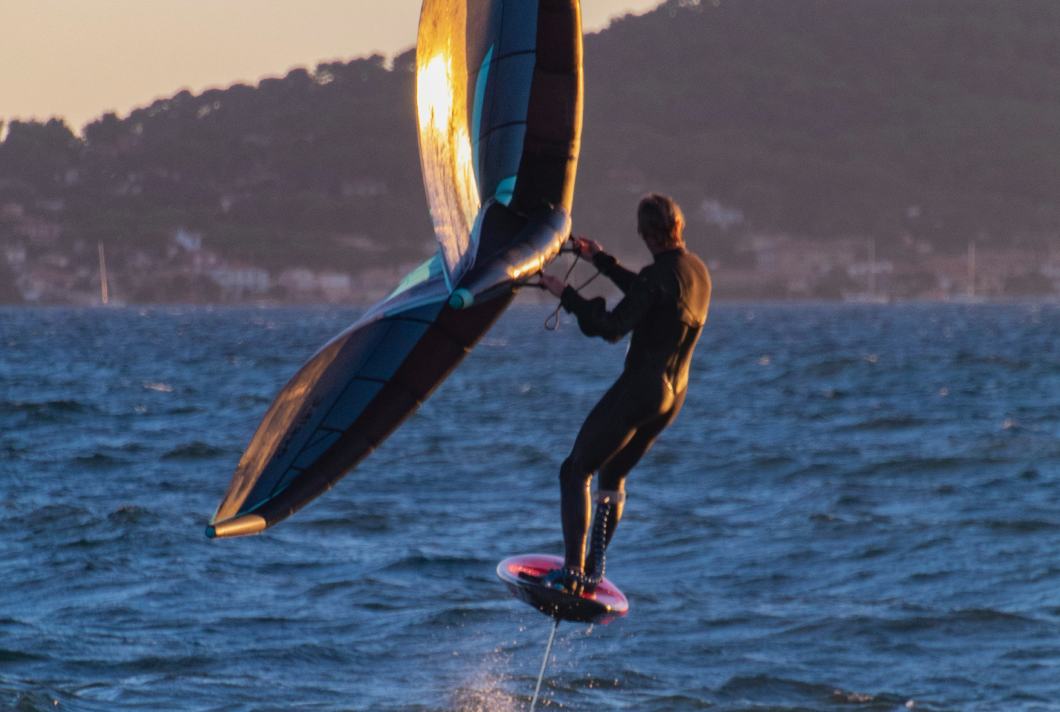
Airtime, in foiling, doesn’t mean jumping clear of the water. It means the time your board is carried by the foil with the hull clear, even if you’re only a few centimetres above the surface.
More time on foil changes the whole session: that is where speed, glide and the technical payoff happen. Every touchdown costs momentum, and every failed transition needs a pump, a reset and extra energy to get back up.
How airtime is measured
The practical way is a watersports tracking setup that combines GPS speed with the shape of the session. Every setup has a takeoff speed: a big wing and high-lift foil fly early, a smaller, faster foil needs more board speed. Speed is a useful threshold, but on its own it can overcount fast planing or downwind drifting, so good analysis also looks at how speed behaves around takeoffs and touchdowns.
To keep the number trustworthy:
- Use the same device, position and settings each session. If you switch from a watch to a board-mounted unit, treat the first sessions as a new baseline.
- Compare like with like. A glassy, steady 18-knot day and a gusty 10-knot day will look very different on paper, even with the same riding.
Waterspeed shows foiling efficiency for each session (Pro).
The metrics that explain efficiency
Efficiency is an outcome. These metrics show why flight started, continued or ended:
- Flight ratio: time on foil vs total moving time. Higher usually means cleaner takeoffs, better trim and fewer unnecessary touchdowns.
- Time to takeoff: how quickly you get up after starting, restarting or coming out of a manoeuvre. A long time points to technique, board speed, foil size, wind angle or timing.
- Average speed while flying: matters more than your fastest burst. A high top speed with a modest flying average suggests you overpush in short sections and give it back in recovery.
- Speed retention through transitions: entry speed, minimum speed and exit speed in tacks and gybes. This is where efficiency usually breaks down.
- Touchdown frequency: normal while learning, but repeated touchdowns in manageable conditions point to instability, line choice or fatigue.
- Context: wind, water state, current, gear and the focus of the session.
Read them together with moving time, distance, average and max speed and the number of tacks or gybes. Speed over 10 or 30 seconds is more useful than a single peak, because it shows usable pace.
How to improve foiling efficiency
Efficiency is mostly about managing drag and unnecessary movement. Every extra pump, sudden weight shift or overcorrection creates resistance.
- Stance first. Most problems start above the foil. A stance that’s too stiff, too upright or too reactive sends pressure spikes into the foil, which causes porpoising, unstable height and speed loss.
- Clean takeoffs. Launch with poor trim, too much pumping or uneven acceleration and you start the flight behind, then spend the next thirty seconds recovering.
- Height control. Too high invites breaches, too low invites touchdowns. Find the middle and hold it.
- Pump less, time better. Over-pumping is one of the clearest signs of inefficiency. More movement rarely means more drive.
- Transitions. You can look efficient in a straight line and still lose huge energy in turns. Every sloppy gybe resets the ride.
- Equipment, after the basics. Mast position, front wing size, stabiliser and board volume all change how easily the foil lifts and how stable it feels. Change one thing at a time and compare similar sessions.
Efficient foiling usually feels quieter: less fighting, less correcting, less dramatic pumping. When the data matches that feeling, you can trust it.
Make it a training target
Give each session one focus: takeoff timing one day, height control the next, transitions after that. Pick one airtime target for the next few sessions. Beginners can aim to increase total flight time or shorten the gaps between flights; intermediate riders often gain most by raising average flight duration, especially through transitions.
Keep the benchmark personal
There is no universal efficiency score that defines a good rider. Beginners spend much of a session on takeoffs and short flights. Advanced riders may deliberately lower their percentage while learning aerials, tight race manoeuvres or technical downwind lines. Compare yourself with your own sessions in similar conditions, not with someone else’s.
The biggest mistake is chasing one metric. Speed alone misses too much, and so does flight time if you’re staying up slowly without control or purpose. For the full session picture, see How to analyse a foil session.