
How to prepare for a great session (before you even hit the water)
You don’t have bad sessions. You have unprepared sessions.
A great session doesn't begin the moment you step onto the board, rig the sail or push off from the dock. It starts before you even touch the water.
Here’s how serious riders prepare — and how you can too.
Define the goal before you launch
Don’t just go out to “ride.”
Decide what today is about:
Improving upwind efficiency?
Holding a cleaner downwind angle?
Reducing speed loss in jibes?
Building endurance?
Testing a new setup?
Without a target, there’s no feedback loop.
Clarity before action = better insights after.
2. Prepare Your Data (Yes, before the water)
Clean data starts before your first tack.
Before launching:
✔ Let GPS fully lock
✔ Check battery levels
✔ Confirm wind direction is correct
✔ Start tracking early
Why wind direction matters? Because metrics like TWA (True Wind Angle) and VMG (Velocity Made Good) depend on it.
Pro tip: Waterspeed automatically downloads wind direction from the Forecast tool, but you can edit it manually from the Edit Menu if needed.
Bad wind input = unreliable analysis.
Preparation isn't just physical anymore. It's digital, too.
3. Understand what ‘Good’ actually means
Some riders evaluate sessions emotionally:
“It felt fast.”
“My tacks were cleaner.”
“I think I was better upwind.”
But feelings don’t tell you what actually happened.
For example:
You might feel faster… but your VMG could be worse if you were sailing at the wrong angle.
You might think your upwind improved… but maybe you only had one strong leg — and the rest were 15–20% behind.
You might feel consistent… but your polar chart could show big gaps between your average and max speed (meaning your best moments weren’t repeatable).
You might blame the conditions… but the data might reveal you perform significantly better on port vs starboard, or that your maneuvers cost you more speed than you think.
That’s where structured analysis changes everything. Because progress isn’t “I had a good day.”
Progress is knowing why it was good — and how to repeat it.
〰️
Progress is knowing why it was good — and how to repeat it. 〰️
4. Prepare your body, not just your gear
The first 10 minutes of your session shouldn’t be your warm-up. They should already be productive.
Before you launch:
Activate shoulders and upper back
Engage your core
Do light dynamic leg work
Take 3–5 deep, controlled breaths
Water sports demand balance, coordination, and reaction speed. If your nervous system isn’t awake, you’re slower to respond — and small delays become big losses in speed and efficiency.
A short warm-up reduces:
Early fatigue
Sloppy maneuvers
Unnecessary crashes
Poor first runs
5. Don’t forget to press ‘Start’
You just had the session of your life, you get back to shore… No track.
Preparation also means eliminating avoidable mistakes. And we’re going to tell you something: Forgetting to press start isn’t bad luck. It’s a broken routine.
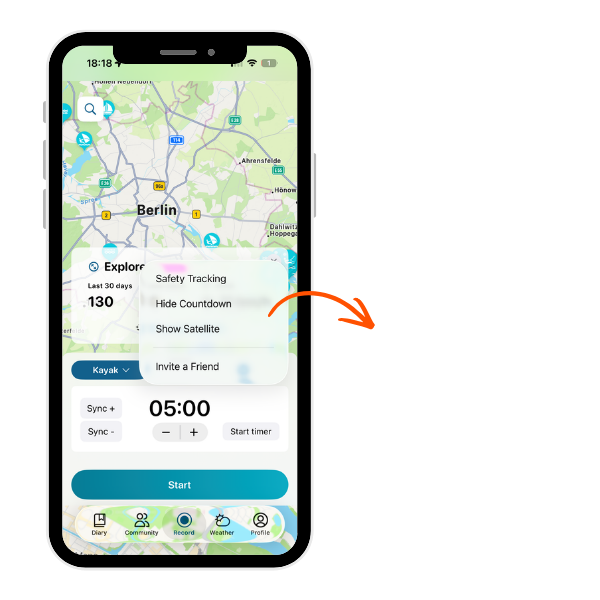
If you race or train with timing structure, Countdown ensures your session starts when it should.
Alerts you at key intervals
Syncs with real race timing
Can be activated directly from Apple Watch
Automatically starts navigation when it ends
Because once the sequence begins, your focus should be on positioning — not on buttons.
6. Set yourself up for review
Preparation includes what happens after the session.
If you want to improve, you need to be able to answer:
Where did I perform best?
Where did I lose speed?
Was I consistent on both sides?
Did fatigue affect my angles or efficiency?
Tracking your session is step one. Reviewing it properly is where progression happens.
When you can clearly see:
Where you were strongest
Where you were inefficient
How consistent you actually were
And what your optimal angles look like
Then, you stop guessing and you start training.
