How to coach kitesurfing with GPS data: what to look at after each session
A practical guide for kite instructors and coaches: what to record, a 10-minute debrief, what to look at in the GPS track at each level, drills that give comparable data, and how to compare riders fairly.
By Paula Acebo
Read in: Italiano · Français · Español · Deutsch · Nederlands · Português

To coach kitesurfing with GPS data, record every session, then spend ten minutes with the rider on the track and the speed chart. Pick the one question that matters at their level: can they stay upwind, can they control speed, or how good is their VMG? Agree on one goal for the next session, and check it on the next track.
GPS does not replace your eyes on the beach. It shows what you could not see: the whole session, every run, and how far downwind the rider drifted while you watched someone else. This guide covers school lessons and independent riders, twin tip, foil and racing.
How is coaching a kite lesson different from coaching independent riders?
In a lesson, you coach in real time and the GPS track is a record. With independent riders, you are rarely close, so the track becomes the main thing you discuss.
In a school lesson, the instructor stays close and corrects each attempt. Some schools talk to students over two-way radios. The Kitesurf Centre, a BKSA and IKO school, uses them in private and foiling lessons and says instructors can give tips from more than 100 metres away. Here the GPS track adds a picture of the whole lesson. It shows the student how far downwind each run took them.
Independent riders train on their own and meet you before or after. You see part of the session from the beach at best. The track fills the gap, and it lets you coach riders at other spots or on other days.
The discipline changes what you look at:
- Twin tip. Staying upwind, speed control, transitions and jibes.
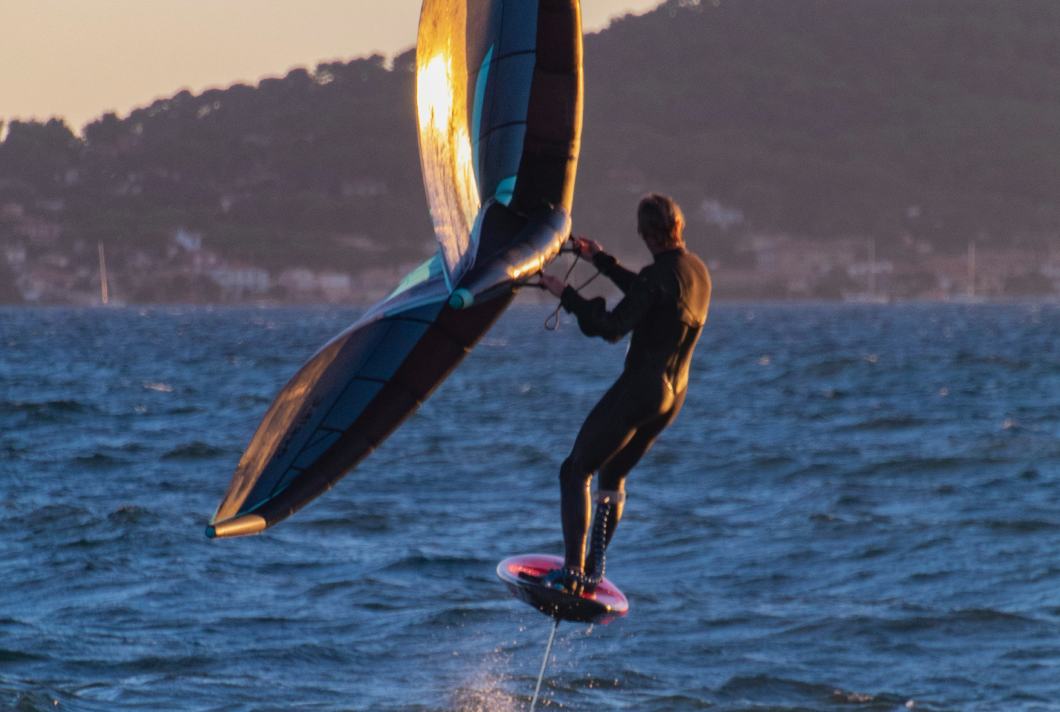
- Kitefoil. Time on foil, restarts after a touchdown, and upwind angle.
- Racing. VMG upwind and downwind, legs, roundings and starts. Formula Kite, the foil racing class, made its Olympic debut at Paris 2024.
What should a kitesurfer record, and how?
Record the whole session with a phone in a waterproof pouch or with a watch. Start before launch and stop after landing, so the track includes the walk back.
- Phone. Use a waterproof pouch fixed to the body, so it does not flap or come loose in a crash. Waterspeed records on iPhone and Android.
- Watch. Record with Apple Watch or Wear OS. On a Garmin, record with the matching activity profile. Garmin, COROS and Suunto sessions sync in.
- Notes. Write down the kite size, the board and the wind for each session. The track does not know them, and you need them to compare.
GPS speed is accurate enough for coaching, but a single spike can be noise. Our guide to GPS accuracy on the water explains what to trust.
How do you run a short debrief after a kite session?
Keep it to ten minutes, on the beach or in a call, with the track open between you. Look at the session as a whole first, then at one detail.
- Ask first. Ask the rider how the session felt and what they worked on. Their answer tells you what to look for.
- Look at the whole track on the map. Check where they started, where they finished and how much ground they gained or lost.
- Replay one part with the speed chart. Choose the run that matches their goal. Watch speed, stops and changes of direction together.
- Name one strength. Point to the place on the track where it shows.
- Name one thing to change. Point to the place where it went wrong, and say what you saw from the beach at that moment.
- Agree on one goal for the next session. Make it something the next track can confirm.
- Write the goal down in the group chat you already use, so you both see it before the next session.
What should you look at in a beginner’s GPS track?
For a beginner, look at one thing: do they stay upwind? Compare the start and the end of each run, and look for the walk back along the beach.
The VDWS kite licence treats this as two separate steps. Its training and exam guidelines list “holding height to windward” at level IV and “gaining height to windward” at level V. The practical exam also checks that the rider can return safely to the starting point.
On the track, this shows clearly:
- Ground lost per run. Each reach drifts a little further downwind. The zigzag looks like a staircase going down the beach.
- The walk of shame. The rider lands downwind and walks back to the launch with the kite. On the map, it is a slow line along the shore. On the speed chart, it is a long stretch at walking pace.
- Transitions. A stop to near zero at each turn, often followed by a body drag or a new water start. Count them, and see which side goes better.
A good first goal is simple: finish the session at the launch, with no walk back. When the walk disappears from the track, the rider is ready to work on more.
What should you look at for an intermediate rider?
Look at speed control, upwind angle and jibes. The rider can now stay upwind, so the question becomes how well they ride.
- Speed control. A smooth speed chart on a reach means the rider edges and sheets well. Repeated spikes and drops mean they overpower, then stall. Compare their best 10 seconds with their typical speed on a run.
- Upwind angle. Look at the angle of the upwind runs on the map. Compare the two tacks. Most riders have a weaker side, and the track shows it.
- Jibes and transitions. Count how many end in a stop and how many keep speed. Our guide on improving jibes with GPS data shows what to look for.
Do not coach jump height from the GPS track. Speed and position say little about how high a rider went. For jumps, use a dedicated jump app; our comparison of kitesurf tracking apps lists which ones measure them.
What should you look at for advanced riders, racers and kitefoilers?
Look at VMG, legs and best speeds. On a foil, add time on foil and the number of restarts.
- VMG. Velocity made good is the speed toward the wind or away from it. A rider can point higher and go slower, or lower and faster. VMG shows which pays. Our explainer on VMG covers the idea.
- Legs. Split a race or a training lap into upwind and downwind legs. Compare the same leg between laps, or between riders on the same day.
- Best speeds. Best speeds over 2, 5, 10, 20 and 50 seconds show peak speed and how long the rider holds it. A rising 50-second figure says more than a new 2-second peak.
- Time on foil. A better foiler flies more and touches down less. Each touchdown means a restart, and each restart costs distance. Our guide to foil session analysis explains how to read it.
The table has one row for each of the four rider groups in this guide.
| Level | Main question | What to look at |
|---|---|---|
| Beginner | Do they stay upwind? | Start and end points, the walk back, stops at each transition |
| Intermediate | Do they control speed and angle? | Speed chart on reaches, upwind angle on each tack, jibe exits |
| Advanced and racing | Are they fast toward the mark? | VMG, legs, best speeds over 10 to 50 seconds |
| Kitefoil | How much do they fly? | Time on foil, restarts, upwind angle |
Which kite drills give comparable GPS data?
Drills with a fixed start, a fixed length and a clear end give data you can compare. Run the same drill at the same spot, and note the wind and the kite size each time.
- Upwind out and back. Ride upwind for a fixed time, then come back to a beach mark. Measure how far upwind of the mark the rider ends. Beginners do it to stop the walk back; racers do it on a foil to measure VMG.
- Reach runs between two marks. Ride the same reach five times at a steady speed. A good rider shows five similar speed curves.
- Ten transitions on each side. Count the ones that keep speed. Compare left and right.
- Timed foil flights. Ride for a set time and count the touchdowns.
- Short upwind and downwind laps. Use two buoys for racers. Compare VMG on each leg from lap to lap.
How do you compare kitesurfers fairly?
Compare a rider with themselves first, in similar wind and on the same gear. Compare riders with each other only when they rode the same spot, at the same time, on similar kite sizes and boards.
Wind matters most. A 12-metre kite in 14 knots and a 9-metre kite in 22 knots give very different speeds. A foil changes everything again. In the public data behind Explore+, kitefoil sessions reached almost the same top speed as kitesurf sessions, about 1 knot lower, in about 3 knots less wind.
We looked at 1,324 sessions recorded as kitesurf and 223 recorded as kitefoil between 20 October and 18 November 2026, each at least 20 minutes long. They come from 340 and 61 riders. The table has four rows: top speed, distance, duration and wind.
| Waterspeed sessions | Kitesurf, median | Kitesurf, middle half | Kitefoil, median | Kitefoil, middle half |
|---|---|---|---|---|
| Top speed | 19.1 kn (35.3 km/h) | 16.8 to 21.9 kn | 18.0 kn (33.4 km/h) | 16.3 to 21.4 kn |
| Distance | 18.6 km | 10.7 to 26.8 km | 18.8 km | 11.6 to 29.4 km |
| Duration | 73 min | 51 to 102 min | 72 min | 52 to 107 min |
| Wind | 13.8 kn | 11.2 to 16.3 kn | 10.6 kn | 7.3 to 13.1 kn |
The middle half runs from the 25th to the 75th percentile. Each row is sorted on its own, so one column is not one session. These are sessions riders chose to make public, not a controlled test.
What goal should a rider take to the next session?
One goal, and one the next track can confirm. Two or three goals split the rider’s attention, and the data cannot show which one changed.
Good goals name a number or a place on the map:
- “Finish at the launch, with no walk back.”
- “Eight of ten transitions without a stop.”
- “Hold the same speed on all five reaches.”
- “Ten minutes on foil with fewer than five touchdowns.”
When a rider stops improving for several sessions, the cause is often outside the drill. Our article on the 7 plateaus in water sports lists the usual ones.
How do you use live tracking for safety and downwinders?
Use live tracking to see where each rider is while they are on the water. It helps most on downwinders and at spots where you cannot see the whole area from the beach.
Live tracking does not replace a rescue plan. Before a downwinder, agree on the route, the landing point, the group size and who drives the car. Ride in pairs, and agree what the person ashore does if a dot stops moving. Our guide to live tracking on the water covers how to share it and what to agree first.
What about privacy and junior riders?
Share only what is needed, and only with the people who need it. For juniors, agree with the parents what you record, who sees it and why.
Make the rules simple and say them aloud:
- Riders choose which sessions they share with the coach.
- Parents of juniors know what is recorded and who sees it.
- Live positions go only to the coach and the people on shore.
- Follow your club or federation safeguarding policy for images and data.
How does Waterspeed help a kite coach?
Waterspeed collects your riders’ shared sessions in one private group. You open each track wherever you are.
- The group. You create a private group, and riders join it. The sessions they share arrive in one place. You see only what they share in the group, never their private sessions. Waterspeed never contacts athletes. For juniors, the offer reaches families only through you.
- After each session. You see the track on the map, speed, distance and a replay of the session with the speed chart.
- Pro. Best speeds over 2, 5, 10, 20 and 50 seconds, two sessions side by side to show what changed, tack and gybe statistics, and foiling efficiency. Set the minimum foiling speed from the 3 dots menu on the activity page. The app then shows foiling time and the foiling sections on the map. Each gap between two sections is a restart.
- Ultra. Legs, runs, tacks and gybes, VMG, true wind angle and polars by leg. This is the level for race coaching.
- Live tracking. With Pro, riders who share their live position show on the map while they ride, from iPhone, Android or Apple Watch.
- Group replay. In the web app, a coach can open several athletes’ sessions together and replay them at the same time.
Give your feedback in person or in the group chat you already use.
Waterspeed has a coach offer: Ultra free for 12 months, and it stays free while 8 of your athletes stay active. Your athletes get 10% off with your own code, and you earn 25% commission on every yearly Ultra subscription bought with it. See how it works on the page for coaches.
Sources: VDWS kite licence training and examination guidelines; The Kitesurf Centre safety page; IKA Formula Kite page, all read 19 November 2026. Session figures from Waterspeed’s public leaderboard data, 20 October to 18 November 2026. We make Waterspeed; corrections are welcome at support@waterspeedapp.com.