
5 numbers that tell the real story of your session
Here's what you're missing if you're only checking speed.
After a good session, almost everyone opens the app and looks at the same thing first: max speed. It's the dopamine number. It's the one we screenshot.
But max speed is a highlight. It's not the story.
If you want to actually understand what happened on the water — and what to work on next time — you need to read your session like a coach would. That means looking at five numbers together, not one in isolation.
Here they are.
1. Max Speed — your highlight number
Your top speed tells you one thing: there was a moment when conditions and technique aligned. Wind was right, your line was clean, your stance held, and the board did what it was supposed to.
That's useful — but only as a marker. Max speed alone doesn't tell you how often that happened, how long it lasted, or whether you could repeat it.
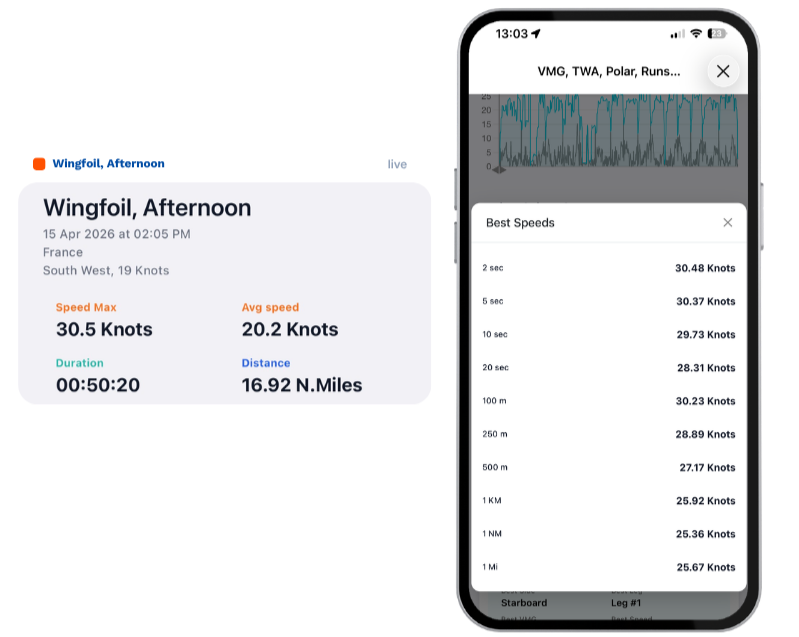
What to look for in the app: open the Best Speeds view and check your 2s, 10s, 100m and 500m bests. The longer the distance you can hold near your peak, the more your top speed actually reflects skill instead of luck.
2. The gap between average and max — your consistency
This is the most underrated number in the app.
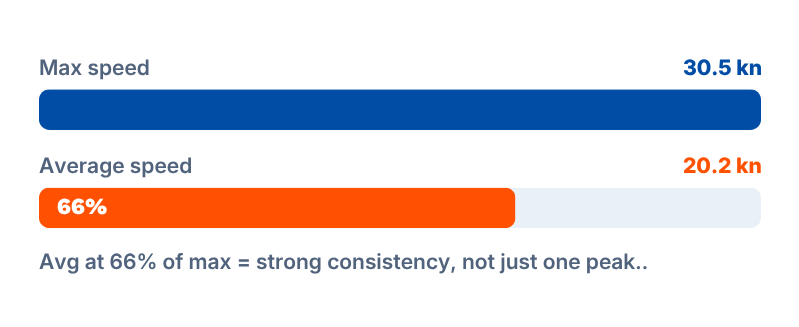
If your average speed is close to your max, you spent most of the session carrying speed. Fewer stops, cleaner transitions, more time on the foil or planing. If your average is far below your max, your session had peaks and a lot of quiet in between.
Quick benchmark: when your average sits around two-thirds of your max, you've had a strong, consistent session. Below half? Something was breaking your flow — bad transitions, lulls, a board not quite dialed in.
This is where you start asking better questions: Where did I lose speed? Tacks? Gybes? Restarts?
3. VMG — fast isn't always efficient
VMG (Velocity Made Good) is how efficiently you're turning your speed into actual progress toward your target line, not just movement across the water.
You can be fast and still inefficient. A wider angle with more raw speed often loses to a tighter angle with less speed. That's why sailors, foilers and downwinders track VMG — it's the real measure of useful speed.
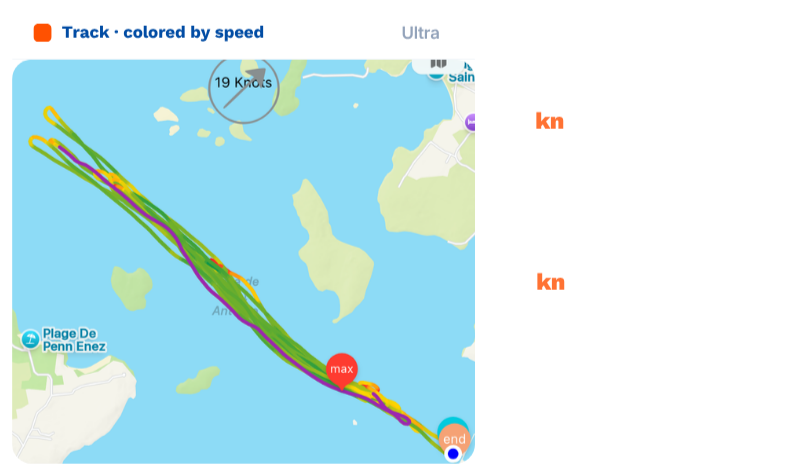
Where to look: Waterspeed Ultra shows your average and max VMG, plus your average TWA (true wind angle). Watch the track colored by speed on the map. Green sections aren't just where you were fast — they're where speed and angle worked together.
If your max VMG is much higher than your average VMG, you have moments of efficiency you're not yet repeating. That's your next session goal.
4. Time on water — active vs total
"I was out for two hours" doesn't mean much if you only moved for forty minutes.
Active time — the time you were actually moving — is the number that explains your fatigue, your progress and your real load. Total time tells you when you launched and when you came back in. Active time tells you what happened in between.
Why this matters: improvement requires reps. If your active time is much lower than your total time, you're spending most of your session standing still — waiting for wind, drifting, recovering. That's fine, but it's also where most progress quietly leaks out.
A session with shorter total time but higher active time will almost always teach you more than a long session full of pauses.
5. Distance — every mile is a rep
Distance is the most honest number on this list.
Top speed can come from one good gust. VMG can spike in one good run. But distance is cumulative. It can't be faked. It compounds across the session and across the year.
How to use it: track your distance week to week and month to month, not just per session. Riders who chase distance — even casually — improve technique without trying, because every mile is a rep. More miles = more transitions = more time finding balance, line and rhythm.
Distance is also what unlocks most of the community side of the app: leagues, group challenges, monthly leaderboards. If you want to plug into the wider Waterspeed community, distance is the easiest way in.
Your 5-number check-in (after every session)
Open your latest session and run through this in 60 seconds:
Max speed — When did it all align?
VMG — How efficient was that toward your target line?
Average vs max — How consistent was the rest of the session?
Time on water — How much of it were you actually moving?
Distance — How many real reps did you bank?
You don't need to act on all five every time. But reading them together turns "good session" or "bad session" into something you can actually train.
