Downwind foiling: how to start, and how to read your first downwinder
Downwind foiling means riding open-ocean swell downwind on a foil board. How to start: the gear, a safe first run, getting up on foil without a wave, and the numbers from 532 downwind sessions that show progress.
By Paula Acebo
Read in: Italiano · Français · Español · Deutsch · Nederlands · Português

Downwind foiling is riding open-ocean swell downwind on a foil board, from one point on the coast to another. To start, learn to take off on flat water first, pick a short run where wind and swell go the same way, and never go alone. On a typical downwinder recorded with Waterspeed, riders covered about 12 km in under an hour and peaked at about 16 knots.
The sport is young. The first Downwind Foil World Tour season ended in July 2026, and the southern summer season in Perth and Hawaii is busy right now. This guide covers the first steps and the numbers that tell you that you are getting better.
What is downwind foiling?
Downwind foiling is a downwind run on a foil board, powered mostly by the swell. You get up on foil, then link one bump to the next so the foil keeps flying with little effort.
Riders get up on foil in three ways:
- With a paddle. SUP foil downwind is the purest form, and the hardest.
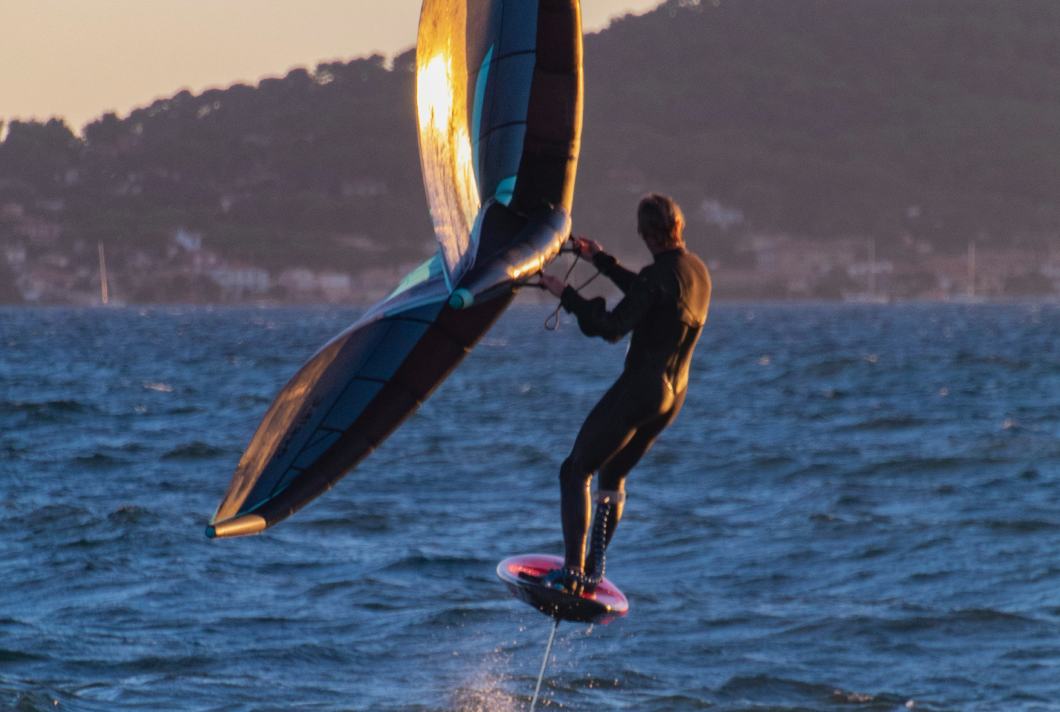
- With a wing. The wing helps you take off, and you fly it neutral between bumps.
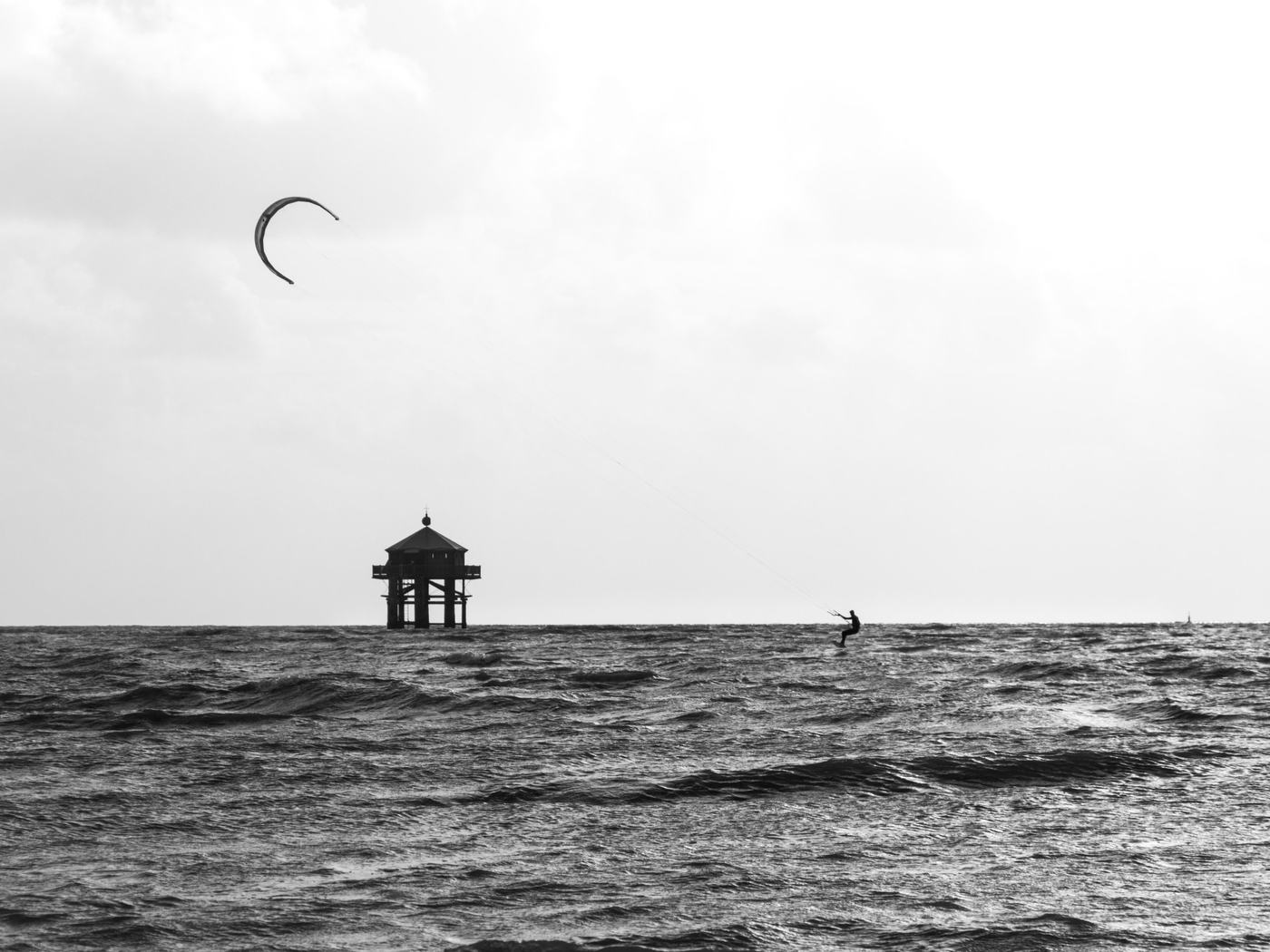
- With a parawing. A small kite-like wing gives power to take off and packs away on your back.
Most runs end several kilometres downwind of the start. So every downwinder needs a plan to get back: a car shuttle, a friend on shore, or a parawing for the ride home.
What gear do you need for your first downwinder?
You need a long, narrow foil board, a large high-lift front wing and a paddle, wing or parawing. For safety, add a leash, an impact vest, a helmet and a phone in a waterproof case.
Length makes the board easier to paddle up to speed. Too much width adds drag. Uni Foil’s downwinding safety guide gives these starting sizes for SUP foil downwind:
| Rider weight | Board length | Board volume | Front wing area |
|---|---|---|---|
| 60 to 70 kg | 7 to 8 ft | 90 to 110 L | 1,800 to 2,200 cm² |
| 70 to 80 kg | 7.5 to 8.5 ft | 110 to 130 L | 1,600 to 2,000 cm² |
| 80 to 90 kg | 8 to 9 ft | 120 to 140 L | 1,400 to 1,800 cm² |
| 90 kg and more | 8.5 to 9 ft and more | 130 to 150 L and more | 1,300 to 1,700 cm² |
Wing foil downwind boards can be about a foot shorter, and parawing boards shorter again, because the wing gives power to take off. Brands do not agree on exact sizes. Sroka, for example, suggests an 8’3 board and a 1,260 to 1,500 cm² front wing for beginners in its five tips for starting downwind foiling. Take these numbers as a starting point and ask a local shop or school.
The leash matters most. A foil board drifts away fast, and swimming back to it in open water is hard. Uni Foil’s guide adds a non-negotiable condition: you must be able to swim at least 1 km in open water.
How do you choose a safe first run?
Choose a short run that you know, where wind and swell go in the same direction and parallel to the coast. Go with a group, and arrange the shuttle before you start.
- Start short. Sroka’s progression starts with 100-metre runs, then 500 metres, 1 km and only later 5 to 6 km.
- Go with others. Riders on foil move at 15 to 20 mph. A rider who falls and paddles moves at about 3 mph. A group spreads out quickly, so agree on where you regroup.
- Tell someone your plan. Give a friend on shore your start, your route, your group size and when you expect to finish.
- Know your exits. Learn the currents and the places where you can come ashore before you need them.
- Stay in range. A phone works near the coast. Far from shore, a VHF radio or a satellite messenger is safer.
How do you get up on foil without a wave?
Paddle hard to build speed, then pump the board in rhythm with your paddle strokes until the foil lifts. Learn this on flat water first.
The flat-water start is the first skill in every progression we read. Once you can take off and keep flying on flat water, move on to small bumps over short distances. Dock starts and pump foiling build the same skill: the pumping that keeps you flying when the swell fades.
Expect short flights at first, and rest between attempts: paddling back up is tiring. A larger front wing lifts earlier and is more forgiving while you learn.
Which numbers show that you are getting better?
The share of time on foil, the number of restarts and the length of your longest flight show progress best. Top speed matters least.
- Time on foil. A better rider flies more and paddles less. This is the clearest single sign of progress. Our guide to foiling efficiency and airtime explains how to read it.
- Restarts. Each fall means paddling back up, which costs the most energy. Fewer restarts on the same run means you link bumps better.
- The longest flight. How far you carry between two restarts shows how well you read the swell.
- Average speed over the run. It grows when you fly more and restart less. Top speed is one moment on one bump, so it says little about the run.
Compare runs on the same stretch of coast in similar wind. The same run in 15 knots and in 25 knots gives very different numbers.
How far and how fast do riders go on a downwinder?
On a typical Waterspeed downwinder, riders covered about 12 km in 54 minutes, peaked at about 16 knots and averaged about 7 knots.
We looked at 532 sessions recorded as downwind between 18 October and 16 November 2026, each at least 20 minutes long, from the public data behind Explore+. They come from 132 riders. Most were in Western Australia and Hawaii, which is where the season is now.
| Waterspeed downwind sessions | Top speed | Average speed | Distance | Duration |
|---|---|---|---|---|
| A quarter of sessions stayed below | 13.9 kn (25.8 km/h) | 4.2 kn (7.7 km/h) | 7.3 km | 38 min |
| Median session | 15.9 kn (29.4 km/h) | 7.3 kn (13.5 km/h) | 11.8 km | 54 min |
| A quarter of sessions went above | 17.9 kn (33.1 km/h) | 9.8 kn (18.1 km/h) | 15.8 km | 81 min |
| The fastest 10% went above | 20.6 kn (38.1 km/h) | 12.0 kn (22.2 km/h) | 21.7 km | 110 min |
Each column is sorted on its own, so one row is not one session. Average speed includes everything: the paddle out, the restarts and the slow minutes at the end. That is why it is less than half the top speed. The median wind in these sessions was 13 knots.
How fast are the best downwind foilers?
Much faster, and for much longer. Edoardo Tanas won the 2026 Molokai 2 Oahu SUP foil race in 2:13:02, his third title in a row, across a channel of more than 40 miles.
That is an average above 15 knots for more than two hours, on a paddle and a foil, with no sail. The official race report says the wind was unusually light, so riders had to read the swell rather than rely on wind. Annie Reickert won the women’s race in 2:52:17.
The race was also the last of the six events of the first Downwind Foil World Tour season, in France, Western Australia and Hawaii. Kai Thompson and Naumi Eychenne finished the season as the first world number ones, as SUPboarder reports.
How do you track a downwinder with a phone or watch?
Record the run with GPS on your phone or watch, share your live position with someone on shore, and review the run when you are back.
With Waterspeed:
- Before you start, turn on live tracking on iPhone, Android or Apple Watch and send the link to your shuttle driver or a friend. They see where you are until you land. Our guide to live tracking on the water explains how to agree on what they should do if something looks wrong.
- On a watch, record with Apple Watch, or with Garmin using the Stand Up Paddleboarding activity profile. Suunto sessions import automatically.
- After the run, set your minimum foiling speed from the 3 dots menu on the activity page. Waterspeed then shows your foiling time and average speed, and you can show the foiling sections on the map. Each gap between two sections is a restart.
- To compare runs, look at your best speeds over 2, 5, 10, 20 and 50 seconds, and replay the run on the map with the speed chart.
Live tracking, foiling efficiency and best speeds are part of Waterspeed Pro. Recording and session replay are free. See what Waterspeed records on the downwind foil page.
Race results from the Molokai 2 Oahu official report of July 2026; season results from SUPboarder, August 2026; gear sizes and safety rules from Uni Foil and Sroka, all read 17 November 2026. Session figures from Waterspeed’s public leaderboard data, 18 October to 16 November 2026. We make Waterspeed; corrections are welcome at support@waterspeedapp.com.