How to start stand-up paddling: board, paddle and first session
Which board to buy, how to hold the paddle, how to stand up without falling in and what to wear. A practical starting guide for stand-up paddling.
By the Waterspeed team
Read in: Italiano · Français · Español · Deutsch · Nederlands · Português

Is stand-up paddling easy to learn? Most people are up and moving in their first session. Getting a stroke that is efficient, straight and comfortable takes longer.
What size board should a beginner buy?
Go wide and long. A common starting range is about 10 to 12 feet long and 30 to 33 inches wide, which is stable enough to learn on. Heavier riders need more volume. Check the maximum weight the manufacturer lists and stay well under it. Inflatable boards are easier to store and transport, while rigid boards usually track and glide better.
How do you hold the paddle?
Beginners often hold the paddle backwards. The blade is angled, and the scoop should lean forward, away from you, so it catches water on the pull. If it feels odd and you are constantly correcting, flip it. One hand goes on top of the handle, the other a comfortable distance down the shaft. Paddle length is a personal fit, so ask the shop or your instructor to size it for your height and the board you ride.
How do you stand up for the first time?
- Start on your knees in the middle of the board, hands on the rails.
- Paddle in that position until you feel steady.
- Place one foot, then the other, around where your knees were, with feet hip-width apart.
- Rise slowly with your chest up and your eyes on the horizon, not on your feet.
- Keep knees slightly bent. A stiff body falls in.
If standing feels wrong on day one, stay kneeling. Nobody is timing you.
How should you paddle?
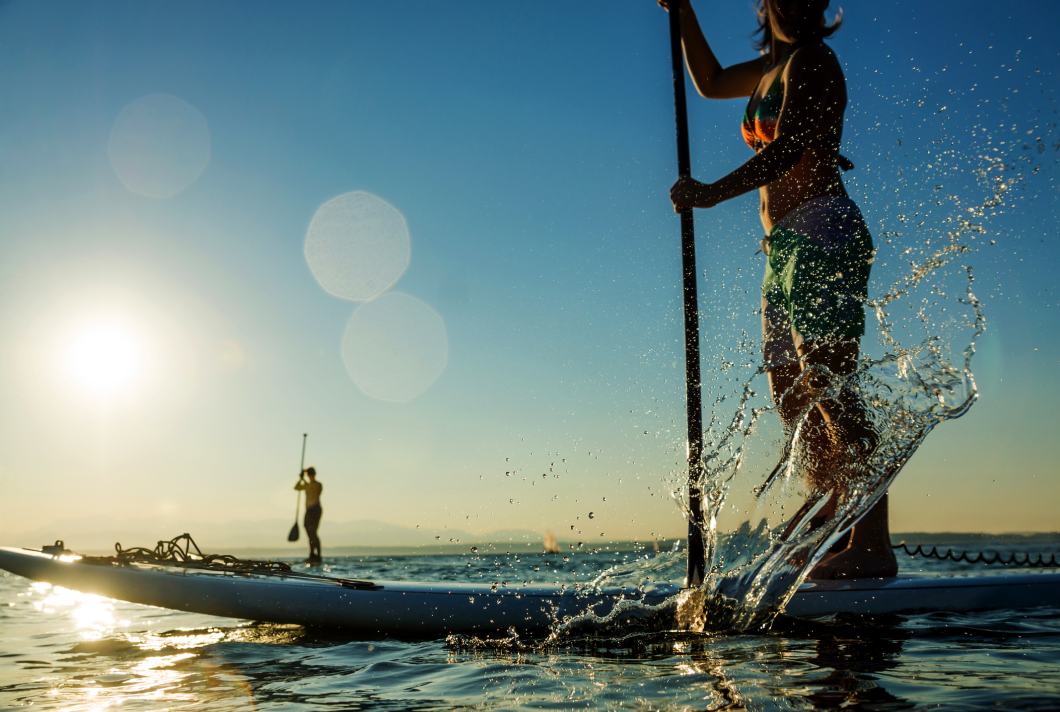
Reach forward from the hips, put the whole blade in the water, and pull it back alongside the board with the top hand pushing down. Pull until the blade reaches your feet, then lift it out. Swap sides every few strokes to keep going straight. If you want to look at your stroke later, our guides on stroke rate and cadence and distance and speed show what to measure.
What safety gear do you need?
- A leash attached to the board, so the board does not blow away from you after a fall. In rivers and flowing water, a leash can snag, so ask a local instructor what is normal there.
- A buoyancy aid. Being able to swim does not stop you getting cold or tired.
- Suitable clothing for the water temperature, not the air temperature.
- A phone in a waterproof pouch, and a plan someone else knows about.
Do not paddle alone on a day with offshore wind. It takes very little breeze to push a board away from shore faster than you can paddle back.
What mistakes do beginners make?
- Staring at their feet.
- Standing at the very back or very front of the board.
- Locked knees.
- Paddling with the arms only, not the core.
- Going out in wind they have not checked.
Book one lesson if you can. A coach sees your stroke in five minutes and fixes habits that are slow to unlearn alone. Then use a tracker or watch app to see your distance and progress.