How fast does a sailboat go? Real speeds from a dinghy to a record-breaking Ultim
Most sailing sessions peak at around 9 knots. Cruising keelboats sail at 5 to 9 knots, foiling Moths pass 30, and a 100-foot Ultim averaged 29 knots around the world. Real speeds, with sources.
Read in: Italiano · Français · Español · Deutsch · Nederlands · Português

Most sailboats sail at 4 to 9 knots (7 to 17 km/h). In the last 30 days of Waterspeed sessions, the typical sailing session peaked at 8.8 knots and averaged 4.2 knots. Foiling boats are in another league: a Moth passes 30 knots, an F50 has reached 58 knots, and a 100-foot Ultim trimaran has sailed around the world at an average of about 29 knots.
The answer depends on two things: whether the hull pushes through the water or rises above it, and whether you mean top speed or average speed.
How fast does a sailboat go on a normal day?
On a normal day, a sailboat peaks at about 9 knots and averages about 4 knots. That is what the Waterspeed data shows.
We looked at 3,197 sessions recorded as sailing between 11 October and 9 November 2026, each at least 20 minutes long. The sessions cover dinghies, catamarans and keelboats, from the public data behind Explore+.
| Waterspeed sailing sessions | Top speed | Average speed |
|---|---|---|
| A quarter of sessions stayed below | 6.6 kn (12.2 km/h) | 3.0 kn (5.6 km/h) |
| Median session | 8.8 kn (16.3 km/h) | 4.2 kn (7.8 km/h) |
| A quarter of sessions went above | 12.6 kn (23.3 km/h) | 5.6 kn (10.4 km/h) |
| The fastest 10% went above | 18.2 kn (33.7 km/h) | 7.3 kn (13.6 km/h) |
The median wind in these sessions was 7.4 knots. Average speed includes everything: the sail out, the tacks, the slow minutes near the shore. That is why it is about half the top speed.
A top speed is one GPS reading, so a single bad fix can push it up. The median is not sensitive to a few bad readings. Our guide on GPS accuracy on the water explains where those errors come from.
What limits the speed of a keelboat?
Hull speed limits a displacement keelboat. As the boat goes faster, its bow wave gets longer. When the wave is as long as the waterline, the boat sits in its own wave trough and needs much more power to go faster.
The usual rule of thumb is:
Hull speed (knots) = 1.34 × √(waterline length in feet)
| Waterline length | Hull speed |
|---|---|
| 20 ft (6.1 m) | about 6.0 kn |
| 28 ft (8.5 m) | about 7.1 kn |
| 45 ft (13.7 m) | about 9.0 kn |
The factor 1.34 is a rule of thumb, not a law of physics. Good Old Boat explains the bow-wave physics behind it, and notes that the waterline gets longer as a boat heels or moves fast, especially with long overhangs. A boat can also pass hull speed for a short time when it surfs down a wave.
That is why most cruising boats sail at 5 to 9 knots: a longer waterline gives a higher hull speed.
Why are dinghies and catamarans faster than their length suggests?
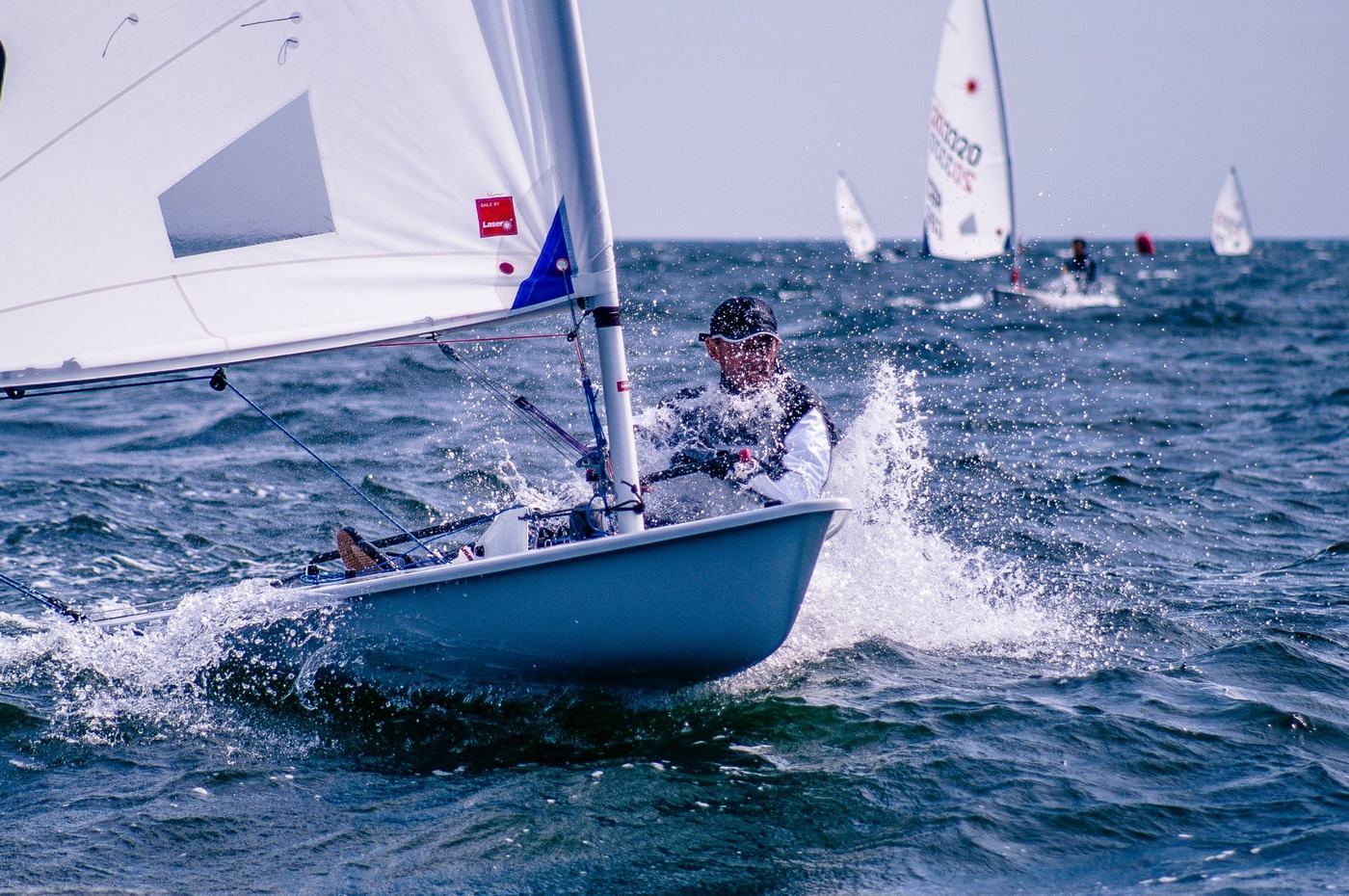
Dinghies plane and catamarans have slender hulls, so hull speed does not limit them in the same way. The formula is for displacement hulls only.
A planing dinghy rises onto its own bow wave and skims across the water. The narrow hulls of a catamaran make a much smaller wave. In both cases, the limit is wind, power and the sailor, not waterline length.
How fast is a foiling dinghy?
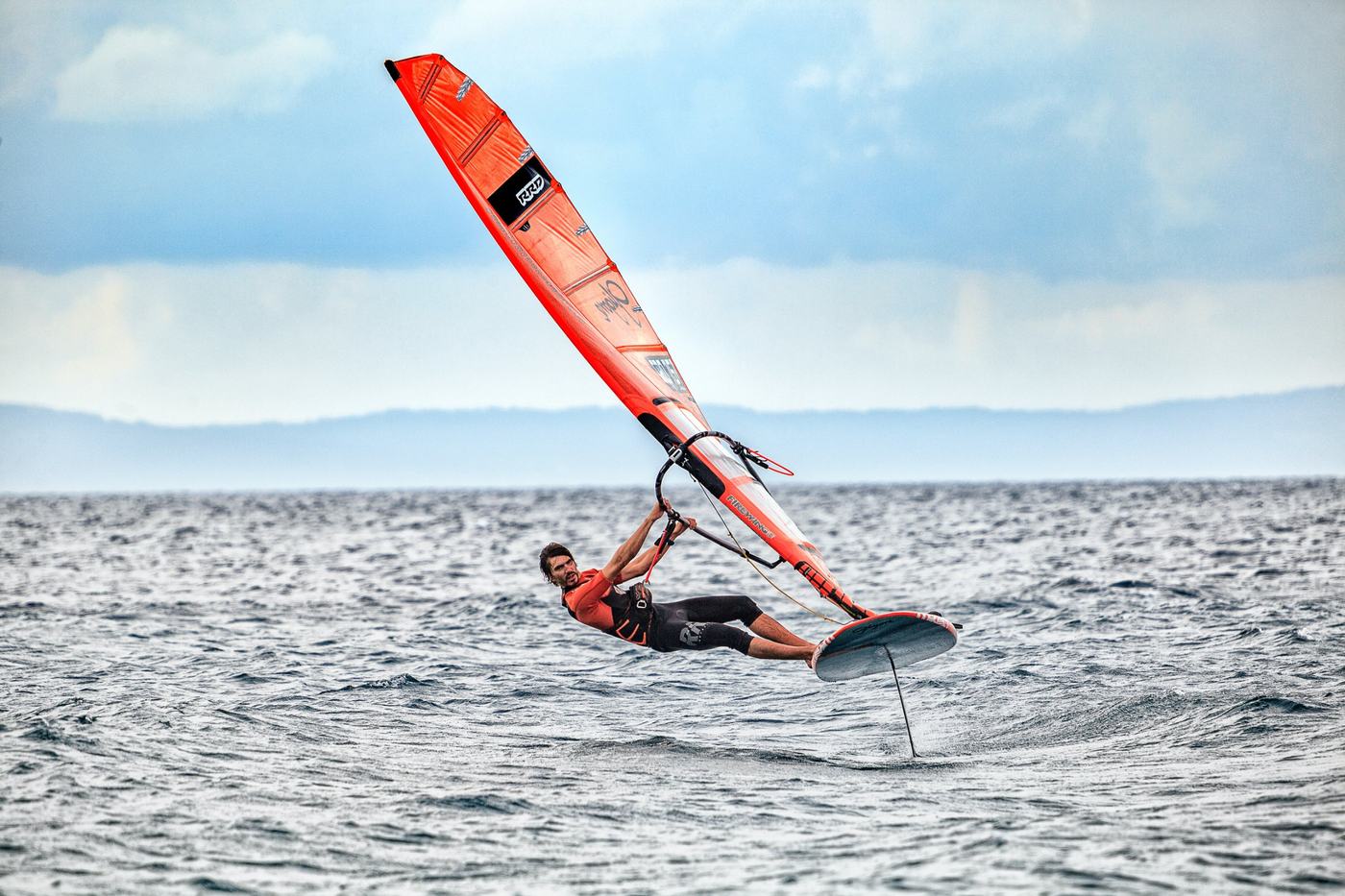
A foiling Moth can pass 30 knots. Yachting World lists its top speed at 30.7 knots (57 km/h), with 25 to 30 knots downwind in 20 knots of breeze.
On a foil, the hull leaves the water and only the thin foils stay in it. Drag falls, so the boat can sail faster than the true wind. For foilers, top speed is only part of the picture: time on foil and takeoff speed matter as much.
How fast are offshore racing boats?
Offshore boats are judged on average speed over weeks, not on one peak. These are the official averages over the distance they sailed:
| Boat and race | Time | Average speed |
|---|---|---|
| IMOCA 60, Charlie Dalin, Vendée Globe 2024-25, solo | 64 d 19 h 22 min | 17.79 kn (32.9 km/h) over 27,668 miles |
| Ultim trimaran, Charles Caudrelier, Arkéa Ultim Challenge 2024, solo | 50 d 19 h 7 min | 23.74 kn (44.0 km/h) over 28,938 miles |
| Ultim trimaran, Sodebo Ultim 3, Jules Verne Trophy 2026, crewed | 40 d 10 h 45 min | about 29.2 kn (54.0 km/h) over 28,315 miles |
Sources: Vendée Globe key figures, Scuttlebutt on the Arkéa Ultim Challenge, Yachting World on Sodebo Ultim 3. We calculated the Sodebo average from the published distance and time.
The Sodebo time beat the 2017 record of IDEC Sport by 12 hours and 44 minutes. The reports at the finish said the record still needed ratification by the World Sailing Speed Record Council (WSSRC).
What is the fastest a sailboat has sailed in 24 hours?
The 24-hour record is 908.2 nautical miles, an average of 37.84 knots (70.1 km/h). Pascal Bidégorry and the crew of the trimaran Banque Populaire V set it in August 2009 (Wikipedia, with WSSRC references).
The solo record belongs to François Gabart: 850.68 nautical miles in 24 hours on the trimaran MACIF in November 2017, according to Guinness World Records. That is 35.4 knots, held for a full day by one sailor.
During the 2026 Jules Verne run, Sodebo Ultim 3 sailed about 870 miles in one day (Yacht). That is close to the crewed record, but below it.
What is the fastest sailboat in the world?
It depends on the measure:
- Outright 500 m record: Vestas Sailrocket 2, 65.45 knots (121 km/h), Walvis Bay, Namibia, 2012. It still stands. Our history of speed on the water tells how the record grew from 26.3 knots in 1972.
- Fastest race boat: the SailGP F50. On 22 August 2026, DS Automobiles Team France reached 107.63 km/h (58.1 knots) in Sassnitz, Germany (World Sailing).
- America’s Cup: INEOS Britannia’s AC75 reached 55.6 knots (103 km/h) in the 2024 Louis Vuitton Cup final in Barcelona (Yachting World).
- Fastest around the world: Sodebo Ultim 3, 40 days 10 hours 45 minutes, 2026.
Top speed and average speed tell different stories. In Portsmouth, the NorthStar F50 peaked at 96.6 km/h, but averaged 78.0 km/h over its best 10 kilometres (full session analysis).
Knots, km/h or mph?
Sailors use knots. One knot is one nautical mile per hour.
- 1 knot = 1.852 km/h = 1.151 mph
- 10 knots = 18.5 km/h = 11.5 mph
- 30 knots = 55.6 km/h = 34.5 mph
How fast is your boat?
Record a session and look at three numbers: top speed, average speed, and your best 10 seconds or 500 metres. Waterspeed shows your best speeds over set times and distances, so one GPS spike does not decide your result. You can also open a GPX or FIT file from a watch in the free GPX and FIT analyzer.
Then compare like with like: the same boat, a similar wind. A fast tack or a cleaner gybe often gains more than a higher peak. Our guide on the metrics that prove you are improving shows what to read beyond top speed.