
Beyond Top Speed: Inside NorthStar’s 96.6 km/h SailGP Session
Top speed gets the headline. Sustained speed reveals the performance.
During its SailGP session in Portsmouth, the NorthStar SailGP Team reached a maximum speed of 96.6 km/h.
It is the kind of number that immediately commands attention. But a single peak only captures one moment.
To understand what was really happening on the water, we need to look deeper: at how long the team maintained its speed, how efficiently that speed translated into progress and how performance changed across different sailing angles.
Tracked with Waterspeed, the full session offers a detailed look at the numbers behind one of the fastest and most technically demanding forms of sailing.
The full session at a glance
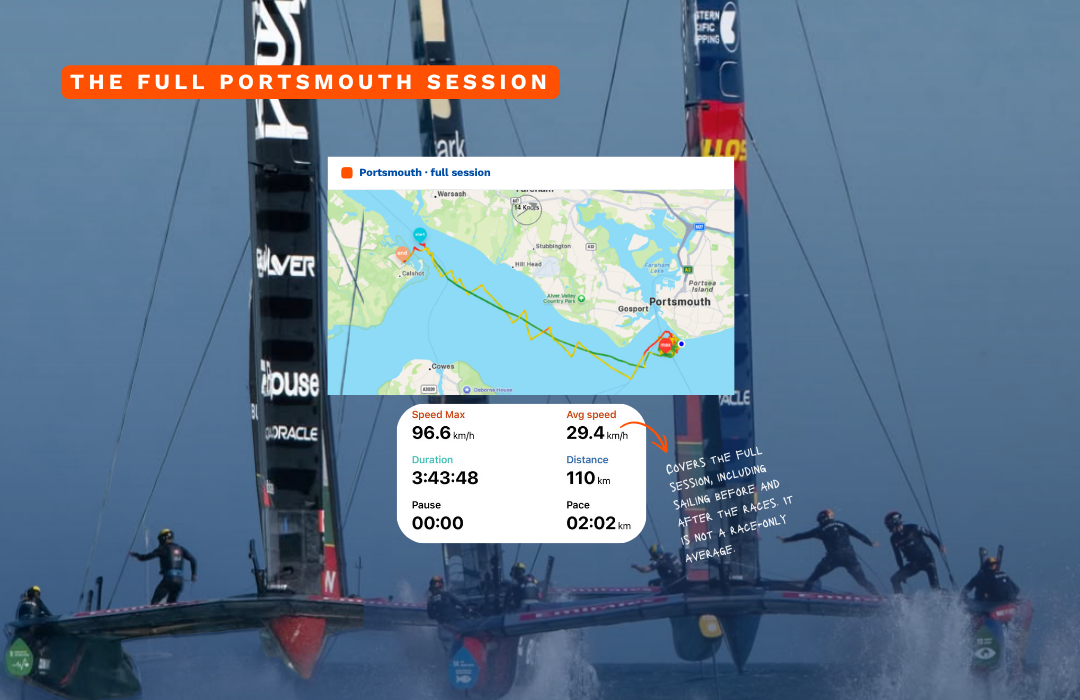
NorthStar covered approximately 110 kilometres during a session lasting 3 hours, 43 minutes and 48 seconds.
Speed sustained over distance
A maximum speed shows the fastest instant of a session. Sustained-speed data shows whether that pace could be maintained.
NorthStar’s numbers remained remarkably strong as the measured distance increased:
500 metres: 88.3 km/h
1 kilometre: 86.5 km/h
5 kilometres: 79.4 km/h
10 kilometres: 78.0 km/h
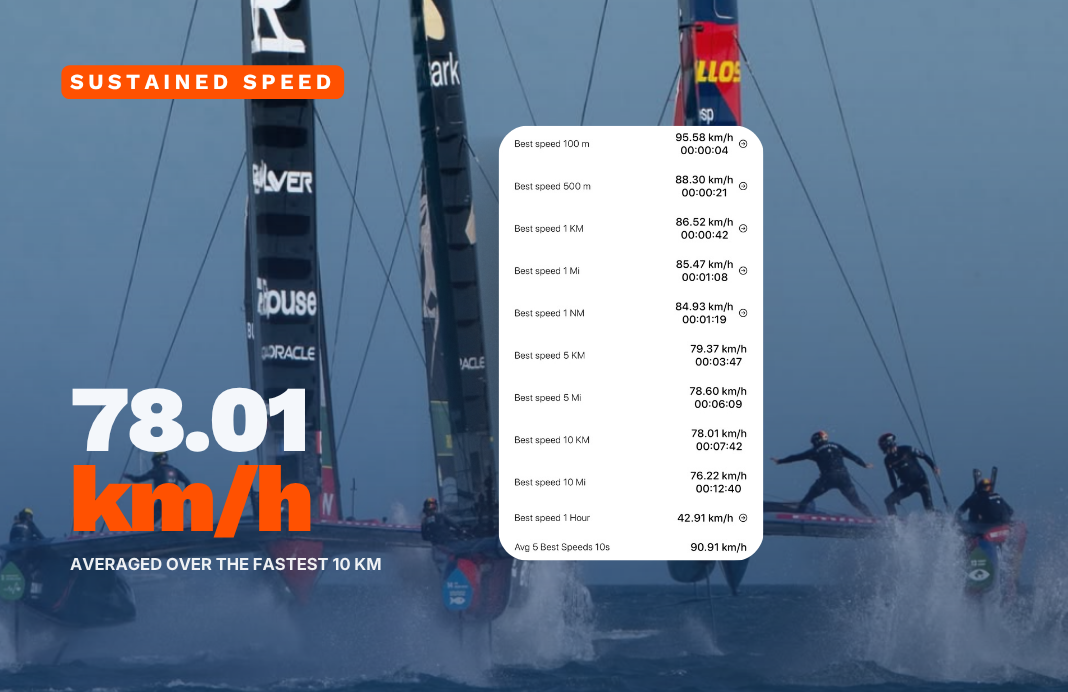
The team averaged 78.0 km/h across its fastest 10-kilometre section.
That is only 10.3 km/h slower than its best 500-metre average.
This relatively small decrease is one of the clearest signs of sustained performance. NorthStar was not simply producing brief bursts of speed. The team was able to keep the boat moving at an exceptionally high pace over a significant distance.
Why sustained speed matters
In high-performance sailing, the highest number on the screen does not necessarily tell you who is sailing most effectively.
A peak can be achieved under a particularly favourable combination of wind, angle and course position. Sustaining speed requires much more:
Consistent foil control
Efficient manoeuvres
Strong coordination across the team
Effective course positioning
The ability to preserve momentum through changing conditions
The longer the distance, the harder it becomes to maintain the same average.
That is why the 78.0 km/h average over 10 kilometres may be more revealing than the 96.6 km/h maximum.
The top speed shows what the boat was capable of for a moment. The 10-kilometre result shows what the team could repeatedly deliver.
Raw speed is not the whole story
Going fast is only valuable when that speed moves the boat in the right direction.
This is where Velocity Made Good, or VMG, becomes essential.
VMG measures how effectively the boat’s speed contributes to progress in the intended upwind or downwind direction. A boat can be travelling very quickly through the water while making less efficient progress toward its objective.
NorthStar’s Waterspeed data recorded:
Upwind VMG: 34.25 km/h
Downwind VMG: 72.70 km/h
The contrast reflects the different demands of each sailing direction.
When sailing downwind, the boat can translate a much greater proportion of its raw speed into forward progress. Upwind, the team must balance speed with a more indirect route relative to the wind.
Finding the fastest angle
The fastest route is not always the most direct one.
Sailing performance depends on finding the angle at which the boat produces the best combination of speed and directional efficiency.
NorthStar’s target data showed:
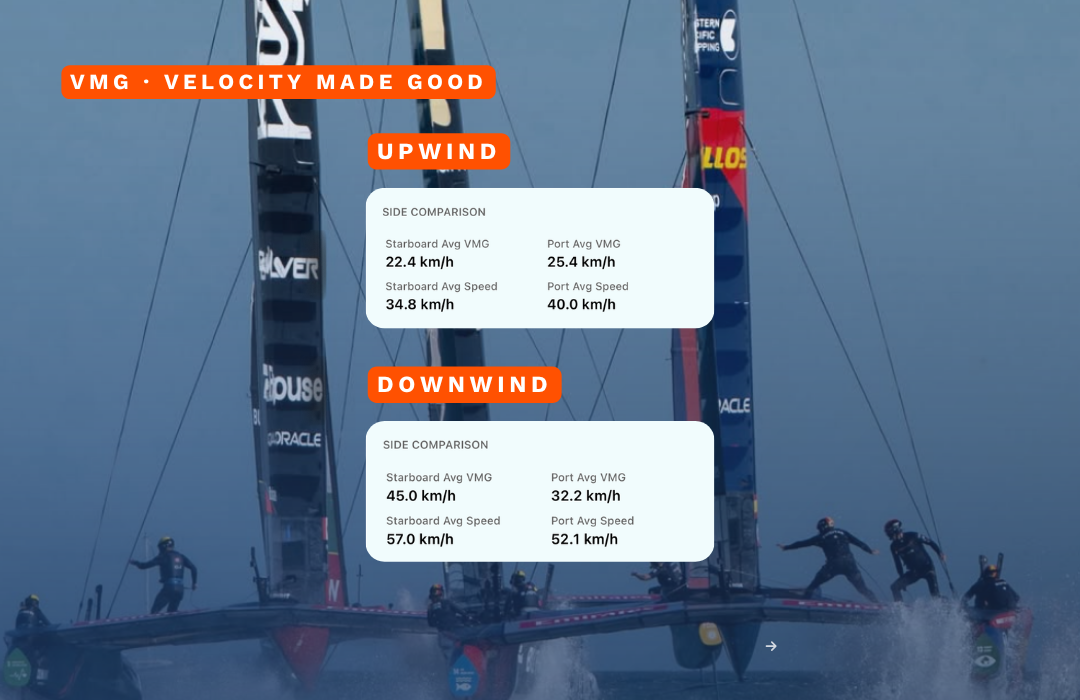
These figures illustrate how differently the boat performs depending on its relationship to the wind.
Downwind, the target speed and VMG are very close. This means that most of the boat’s speed is contributing directly to useful progress.
Upwind, the difference is greater because the boat cannot sail directly into the wind. The team must choose an angle that balances boat speed against the additional distance travelled.
This is the strategic layer hidden behind the headline speed.
Performance lives beyond top speed
A peak speed is easy to celebrate.
The deeper performance story lies in everything required to reach it, sustain it and turn it into progress around the course.
That is the difference between recording a fast moment and understanding a complete session.
You watched the race. Waterspeed reveals the performance behind it.
Track your own sailing sessions with Waterspeed and go beyond your top speed.
Ready to see what is happening beyond your top speed?
Track your sessions, analyse sustained speed, review your sailing angles and uncover the performance behind every kilometre with Waterspeed.
