How to sail into the wind: close-hauled, trim and tacking
No boat sails straight into the wind. How close you can point, how to trim and steer by the telltales, how to keep the boat flat, how to tack step by step, and how to check your progress with GPS.
By Paula Acebo
Read in: Italiano · Français · Español · Deutsch · Nederlands · Português

You cannot sail straight into the wind. You sail at an angle to it, close-hauled with the sails pulled in tight, and zigzag towards your goal by tacking from one side to the other. Most dinghies and small keelboats sail at roughly 40 to 50 degrees to the true wind, so each tack turns the boat through about 90 degrees.
What is the no-go zone?
It is the arc on either side of the wind where your sails cannot work. Point the boat into it and the sails flap, the boat slows and soon stops.
The zone is roughly 40 to 45 degrees on each side of the wind for most boats. A boat with efficient sails and foils has a smaller zone than a heavy cruiser. If you stop head to wind, you are “in irons” (more on getting out below).
How close to the wind can a boat sail?
Typically 40 to 50 degrees to the true wind for dinghies and small keelboats, and closer for efficient racing boats. The exact angle varies with the boat, the sails, the wind strength and the waves.
The general range quoted for sailing boats is 30 to 50 degrees. The RYA gives about 40 degrees as a practical limit. That is the angle you can hold, not always the best one. Pointing as high as possible often makes you slow. The best upwind angle is the one that gets you to windward fastest, which is a trade between speed and angle.
How do you find close-hauled?
Pull the sails in tight, then steer towards the wind until the front of the jib (or the mainsail on a single-sail boat) starts to flutter. Then bear away a little until it fills again.
That is the edge of the no-go zone. As the wind shifts, steer to stay on that edge.
How do you trim and steer by the telltales?
Watch the telltales on the jib luff: when both sides stream straight back, you are on course. If the windward one flutters, bear away or sheet in. If the leeward one flutters, head up or ease the sheet.
Telltales are short strips of yarn on both sides of the sail, near the front edge.
- Windward telltale fluttering or lifting: you are too close to the wind. Bear away a little.
- Leeward telltale fluttering or stalling: you are too far off the wind, or the sail is pulled in too tight. Head up a little, or ease the sheet.
Upwind, set the sails and then steer by the telltales, rather than trimming all the time. A windward telltale that lifts from time to time is fine, but do not let the leeward one stall for more than a second or two. Check the upper telltales too, as they can tell a different story from the lower ones.
Steer with small, steady movements. Upwind steering is a series of continual small turns, not big swings of the tiller.
How do you control heel?
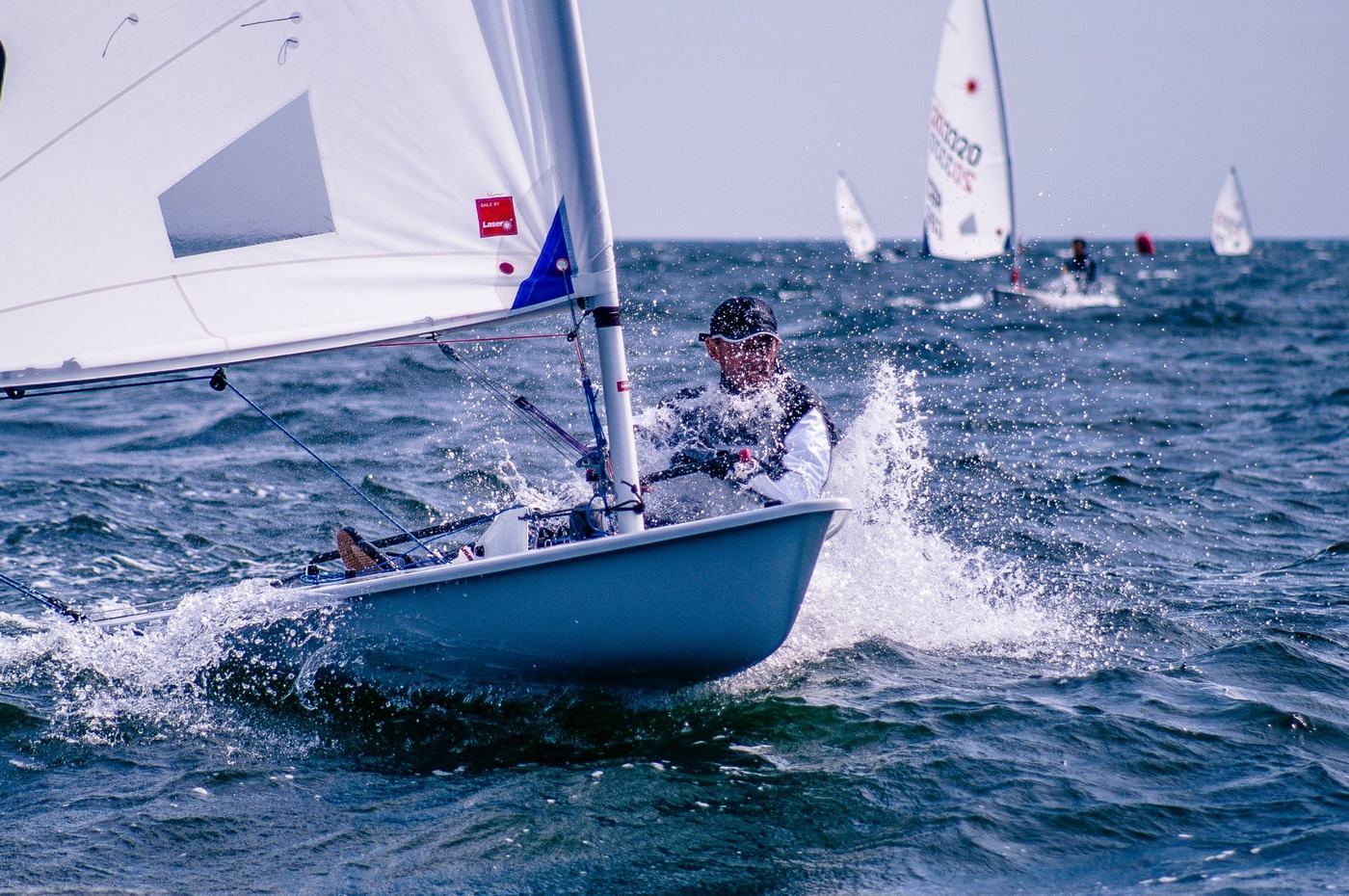
Keep a dinghy flat, and a keelboat at a moderate heel. Too much heel makes the helm heavy and the boat slow.
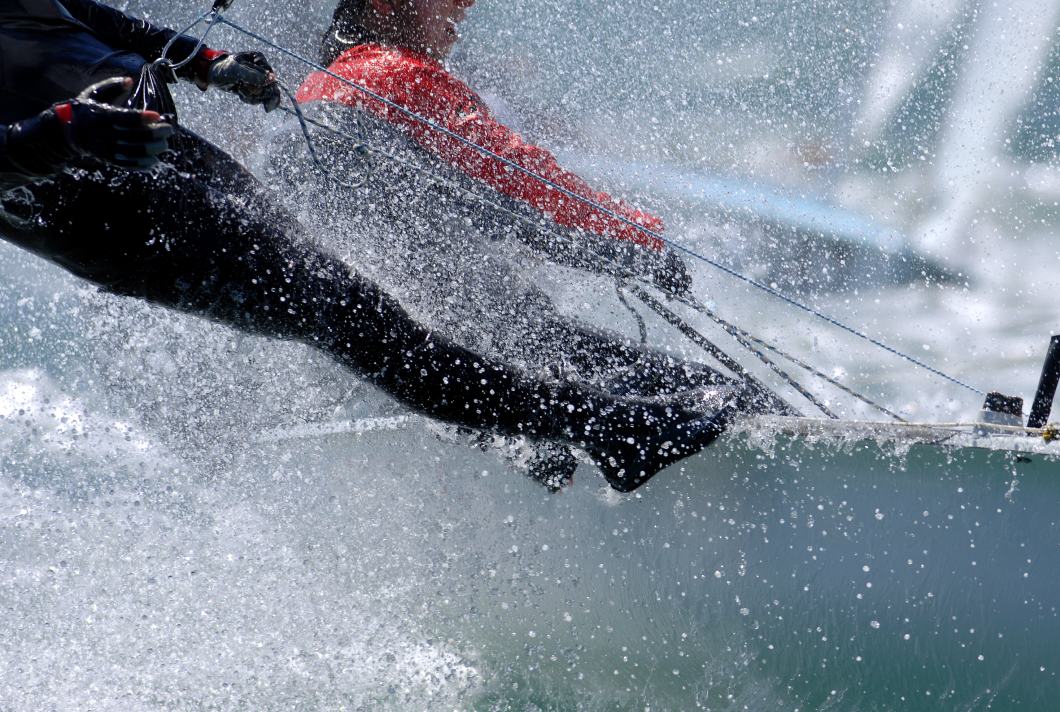
In a dinghy, sit out (hike) on the windward side to balance the pull of the sails. When a gust hits, ease the mainsheet to spill wind, then pull it back in as the gust passes. In a small keelboat some heel is normal, but the best heel angle is often less than people expect. Most boats sail best upwind with just a little weather helm, meaning a light pull on the tiller towards windward. If the tiller pulls hard, depower: ease the traveller down or ease the mainsheet.
How do you tack, step by step?
Tacking turns the bow through the wind so the wind comes over the other side. On a two-person dinghy:
- Sail close-hauled with good speed. A slow boat often stops halfway through the turn.
- Check the water ahead and on the new side is clear, and that you have room to turn.
- Call “Ready about”. The crew prepares the new jib sheet and answers “Ready”.
- Call “Lee-oh” (or “Tacking”) and push the tiller smoothly towards the sail. Do not jam it over: a sudden turn acts as a brake.
- As the bow passes through the wind, the crew releases the old jib sheet when the jib backs, and pulls in the new one.
- Duck under the boom and move across to the new windward side, swapping hands on the tiller and mainsheet.
- Straighten the tiller a little below your new close-hauled course: lower in light wind, close to course in a strong breeze.
- Let the boat build speed, then trim in and head up to close-hauled.
The aim is not to get from one tack to the other as fast as possible, but to carry as much speed as you can through the turn.
What if you get stuck in irons?
Push the boom out to one side and the tiller the same way. The boat moves backwards and turns. When the sails fill on a beam reach, straighten the tiller, sheet in and go. Tack decisively next time, with speed.
What are the most common upwind mistakes?
- Pinching: steering too close to the wind. The windward telltales lift, speed drops and you slip sideways.
- Sails pulled in too tight. The leeward telltales stall and the boat feels heavy.
- Too much heel. Ease the sheet or hike harder rather than fighting the tiller.
- Oversteering with large tiller movements, which acts as a brake.
- Tacking without speed, or turning too far and coming out above close-hauled.
How do you check your upwind progress with GPS?
Look at your VMG and your tack angle. VMG shows how fast you actually move towards the wind; the tack angle shows how high you point on each side.
VMG (velocity made good) is your boat speed multiplied by the cosine of your true wind angle. At 4.5 knots and 45 degrees, your VMG is about 3.18 knots. Sailing faster but wider can give a lower VMG, so compare angles instead of chasing top speed. What is VMG? has worked examples.
Your tack angle is the difference between your headings on port and starboard tack. If one side is wider than the other, the wind may have shifted, or your trim or steering may differ between the two sides. A GPS track measures movement over the ground, so current and sideslip also show up in it.
Waterspeed calculates VMG and true wind angle from your GPS track and the session’s wind direction. It splits a session into upwind and downwind legs, compares port and starboard, and measures entry and exit speed for each tack. To test your best angle, try the three-leg test in Upwind angles and VMG in a dinghy.
Related: What is VMG?, Upwind angles and VMG in a dinghy, Sailing knots every sailor should know, Tacks and gybes analysis.